
Texte écrit à l’occasion du colloque “Tisser/ Créer, réinvention de l'art textile de 1945 à nos jours”, qui s'est tenu les 8 et 9 novembre 2025 au Musée Bourdelle et à l'Institut Polonais, Paris.
Doris Salcedo : art, politique, actes de deuil et textile
Doris Salcedo est une sculptrice colombienne née en 1958 à Bogotá, dont la vie et l’œuvre ont été profondément façonnées par les expériences politiques et historiques de son pays. Elle obtient une licence en beaux-arts à l’Universidad Jorge Tadeo Lozano de Bogotá en 1980, avant de partir à New York où elle décroche un Master of Fine Arts à l’Université de New York. Elle retourne ensuite à Bogotá pour enseigner à l’Universidad Nacional de Colombia.
À son retour en Colombie, Salcedo s’intéresse intensément aux conséquences humaines de la violence(1). Son œuvre est imprégnée d’un profond sentiment de perte et de mortalité, enraciné dans son histoire personnelle : plusieurs membres de sa famille comptent parmi les nombreux disparus de la Colombie politiquement troublée. Son art aborde le fait que, si la mort d’un être cher peut être pleurée, sa disparition laisse un vide insupportable. Ses sculptures répondent souvent aux témoignages d’amis et de proches de victimes tuées durant sa vie. Elles prennent fréquemment la forme de meubles domestiques transformés, d’éléments d’aménagement intérieur ou de vêtements et textiles laissés derrière eux par les personnes disparues.
Entre 1985 et 1990, le travail de Salcedo est influencé par Joseph Beuys, dont la pratique lui révèle la possibilité d’affronter le traumatisme dans une perspective historique. Durant cette période, son art se concentre sur la révélation de faits dissimulés par l’histoire officielle, le thème central étant la douleur de l’expérience humaine. L’artiste intègre souvent des textiles et divers matériaux dans ses œuvres.
En 1989–1990, elle réalise Las Camisas (Sans titre), une œuvre abordant le destin des personnes disparues, l’impact de la violence sur leurs familles et les rituels quotidiens accomplis pour préserver leur mémoire. La pièce se compose d’une pile de chemises d’homme en lin blanc immaculé, ayant appartenu à des personnes disparues « dans des circonstances inexpliquées ».
Parmi les autres œuvres utilisant le tissu figure A Flor de Piel (littéralement Fleur et peau, 2011–2012), créée en mémoire de la torture et de la mort d’une infirmière colombienne, victime de la violence. Pour cette œuvre, Salcedo a confectionné un tapis-textile à partir de milliers de pétales de roses, formant un linceul situé entre la vie et la mort, entre matérialité et immatérialité.
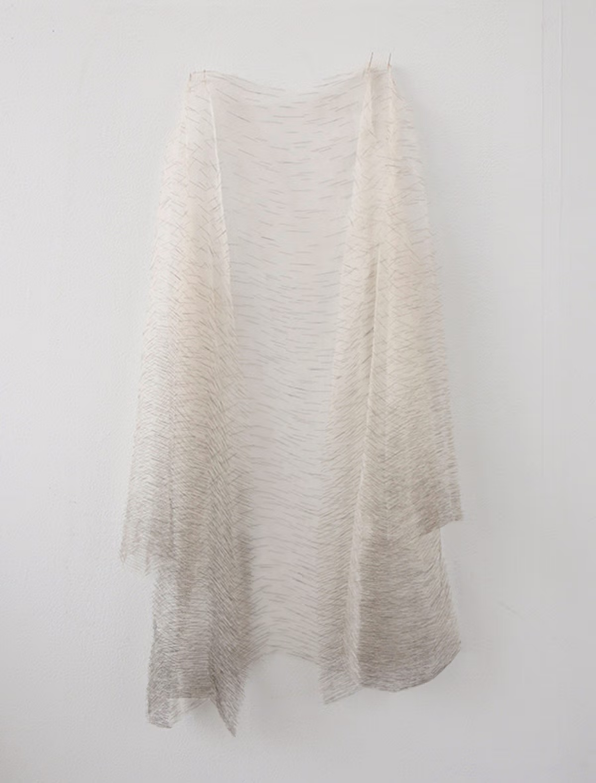
Un autre exemple d’œuvre utilisant le textile est Disremembered X (2020–2021), une série de trois linceuls textiles éthérés. Salcedo y a inséré des milliers d’aiguilles dans un tissu blanc translucide, cousu à partir de soie brute d’une douceur presque vaporeuse, créant un vêtement d’une beauté troublante, proche de la pénitence. L’œuvre évoque l’impossibilité d’exprimer pleinement le chagrin et le deuil, l’incompréhension des autres et l’effacement progressif de la mémoire.
Dans cette présentation, je vais analyser plusieurs installations de Doris Salcedo selon un ordre chronologique. Je me concentrerai sur trois œuvres réalisées à différentes périodes, reliées par l’usage du tissu comme matériau principal, chargé d’une signification symbolique particulière. J’examinerai des œuvres intégrant des vêtements authentiques appartenant à des personnes disparues dans des circonstances obscures, ainsi que des installations explorant la puissance symbolique du textile. Au cœur de ces œuvres se trouve l’essence même du tissage : l’entrelacement des fils, la fonction du matériau, ses connotations féminines et l’archétype de la création féminine.
Las Camisas est une œuvre dédiée aux personnes disparues. D’une part, le projet visait à commémorer la mort d’innocents luttant contre le narcotrafic en Colombie ; d’autre part, il faisait référence aux rituels de commémoration des morts. En évoquant les traditions populaires des Indiens colombiens liées au deuil, à l’enterrement et au chagrin, Salcedo condamne indirectement les responsables de ces morts inexpliquées.
Souvent, les proches des morts et des disparus ne peuvent jamais enterrer leurs êtres chers ; il ne leur reste que leurs vêtements. L’installation se compose d’un amas de chemises d’homme en lin blanc immaculé, appartenant à des personnes disparues « dans des circonstances inexpliquées ». Les chemises sont maintenues par des tiges d’acier ; l’œuvre parle de sacrifice et de mémoire, de souffrance et de politique en Colombie.
La pratique artistique de Doris Salcedo contribue au développement d’un art de la mémoire et de la conscience. Bien que ses œuvres soient empreintes de tristesse, elles ne peuvent être assimilées à des monuments traditionnels. L’artiste matérialise l’absence, l’oppression et le fossé entre injustice et pouvoir. Ses sculptures et installations abordent la violence et les conflits de la vie quotidienne en Colombie, à la fois comme réflexion et comme réponse.
Salcedo conçoit son art comme une expression de la conscience civique, tout en agissant à la fois comme témoin et accusatrice. Bien que ses œuvres semblent inspirées d’expériences personnelles, elles attirent l’attention sur des questions universelles liées à la violence et à la condition humaine. En ce sens, ses œuvres donnent une voix à des membres de la société colombienne brutalement réprimés et réduits au silence, tout en soulignant un sentiment de communauté — voire de résistance — à travers la mémoire collective et l’expérience partagée de la perte. « Salcedo utilise des matériaux, des objets et des traces de la vie quotidienne appartenant aux victimes, tels que les vêtements, afin de souligner l’humanité de ceux que la violence a rendus anonymes. »
Las Camisas fut l’une de ses premières œuvres, présentée à Bogotá à la galerie Garcés Velázquez(2). Elle se compose de fragments de structures métalliques servant de supports à des lits de camp ou des lits d’hôpital. Salcedo les enveloppe de fibres naturelles semblables à des bandages, comme pour recouvrir une blessure. À côté de ces structures — les plus anciennes de son œuvre, dédiées à ce qu’elle nomme des « actes de deuil » — elle installe une série de pièces composées de chemises blanches en coton, soigneusement disposées en onze colonnes. Les chemises sont rigidifiées au plâtre et transpercées de longues tiges métalliques.
À partir de cette œuvre, le thème du deuil devient central dans sa pratique artistique. Las Camisas constitue une réponse aux massacres perpétrés dans les plantations de bananes de Hondura et La Negra, au cours desquels des paysans furent assassinés pour des raisons demeurant obscures. L’artiste évoque la présence du corps humain absent sans jamais montrer le crime directement. Les vêtements laissés derrière — seuls témoins matériels — deviennent porteurs de mémoire. Les chemises blanches renvoient à la fois aux vêtements traditionnels des ouvriers agricoles et aux habits du deuil. Empilées de manière irrégulière, elles deviennent une mesure de la vie humaine elle-même.
L’œuvre se compose de seulement deux éléments : les chemises blanches et les tiges métalliques. Les murs de la galerie sont également blancs et, sur ce fond austère, les éléments métalliques évoquent des instruments de torture. Les tiges d’acier sont noires, de hauteur uniforme, mais leur nombre varie selon les piles. Elles sont toutes placées du même côté, à gauche, au-dessus du centre de la chemise. Par le contraste entre la blancheur immaculée des chemises, leur repassage et leur pliage soignés — rappelant le soin autrefois apporté par les femmes — et la brutalité de la perforation métallique à hauteur de poitrine, l’artiste fait appel à l’émotion et à la douleur de la perte. Ce contraste provoque également un sentiment de protestation face aux stratégies politiques visant à dissimuler le crime.
Une autre œuvre de Doris Salcedo utilisant le tissage de manière non conventionnelle est A Flor de Piel, réalisée entre 2011 et 2016.
Cette expression espagnole signifie « une émotion extrême », un sentiment si intense qu’il exige d’être exprimé. Elle évoque le lien entre la fleur et la peau humaine, suggérant une émotion qui se manifeste physiquement. Salcedo décrit elle-même cette œuvre comme l’accomplissement d’un rituel funéraire refusé à la défunte.
A Flor de Piel, souvent qualifiée de sculpture, fut créée en mémoire d’une infirmière colombienne enlevée, torturée et assassinée, restée anonyme. Durant la guerre civile colombienne (1964–2016)(4), elle avait soigné des blessés des deux camps. La sculpture textile est constituée de milliers de pétales de roses cousus à la main pour former un linceul délicat et léger. Déposé au sol, il ondule doucement au moindre mouvement d’air. Chaque pétale a été traité chimiquement pour conserver sa couleur sombre et sa souplesse, puis cousu avec du fil chirurgical, comme une plaie recousue par un chirurgien(5). Les pétales, soumis à la décomposition naturelle, existent dans un état intermédiaire entre la vie et la mort. Leur extrême fragilité constitue le cœur même de l’œuvre. Salcedo souhaitait créer ce qu’elle appelle un « matériau immatériel ». Elle décrit l’œuvre comme « une offrande florale pour toutes les victimes, pour tous ceux touchés par la violence ».
« Coudre les pétales était essentiel », explique-t-elle. « La violence détruit tout. La torture détruit les corps. L’idée était de les rassembler, de les réunir, de leur rendre leur force(6). »
La réalisation de ce tissu de pétales a duré près d’un an. Ce processus lent et rituel remplace symboliquement la toilette mortuaire et l’enveloppement du corps, un geste traditionnellement confié aux femmes. En utilisant des formes de travail historiquement féminines — couture, tissage, patience — Salcedo unit vie et mort, matière et immatérialité.
De loin, le linceul semble fait de peau fine ; de près, il révèle une texture presque immatérielle. Sa surface vibrante, sa couleur brun sang et ses coutures visibles lui confèrent un caractère méditatif et commémoratif. En utilisant des pétales, Salcedo s’inscrit, consciemment ou non, dans la longue tradition des femmes tisserandes, remontant aux origines mêmes du textile.
L’œuvre suivante est Disremembered X(7), créée en 2020–2021.
Le titre renvoie au mot « disremember » utilisé par Toni Morrison dans son roman Beloved (1987), désignant un oubli volontaire — l’effacement de tragédies passées qui continuent pourtant à hanter le présent. Cette installation est née de conversations avec des centaines de mères américaines ayant perdu leurs enfants à cause des armes à feu. À Chicago, en 2021, le nombre de décès liés aux armes atteignait un niveau record depuis vingt-cinq ans. « Quand on perd un parent, on devient orphelin. Mais la douleur d’une mère endeuillée n’a même pas de nom (8)», dit Salcedo.
L’installation se compose de quatre éléments évoquant des « robes de mort ». De tailles différentes, ce sont des vêtements amples, presque transparents, tissés à partir de fils de soie blanche brute, doux comme une gaze médicale. Leur beauté est trompeuse : il s’agit de chemises pénitentielles ou funéraires. Dans le tissu translucide, l’artiste a inséré des milliers d’aiguilles, conférant à l’ensemble une luminosité éthérée tout en repoussant le spectateur. Ces aiguilles, entremêlées aux fils de soie, créent une matière mystérieuse oscillant entre cotte de mailles, robe angélique et linceul. Leur poids est perceptible dans l’affaissement des plis — vêtements conçus pour aucun corps vivant.
Suspendues contre un mur blanc, parfois semblant flotter ou être jetées négligemment sur un clou, ces robes provoquent un sentiment de désorientation. Le silence du lieu est ponctué d’un léger bruissement — une supplique pour la mémoire. Le textile devient presque invisible ; seule demeure la lueur fragile des aiguilles, comme « l’écho d’une voix d’enfant qui n’est plus là (9)».
L’œuvre a profondément résonné aux États-Unis. De nombreuses personnes endeuillées ont exprimé leur douleur, notamment sur les réseaux sociaux. Les médias américains ont analysé le travail de Salcedo dans le contexte de la violence armée(10), dénonçant l’inaction gouvernementale, l’effacement de la mémoire collective et le racisme structurel. Disremembered X, bien que presque immatérielle, rend la douleur, la perte et le deuil presque tangibles. Salcedo fait remonter à la surface un passé refoulé, convoquant les fantômes de tragédies antérieures. La force de son art réside dans sa capacité à révéler sans compromis le traumatisme, l’émotion et l’empathie(11).
Les œuvres textiles de Salcedo constituent ce qu’elle nomme une « topologie du deuil ». Textiles, sculptures, installations et projets publics — tels Atrabiliarios, Istanbul ou Shibboleth — représentent une « suspension constante entre le présent et le passé »(12). Dans son travail, le tissu, la couture et le tissage deviennent un portrait : « non seulement un portrait de la disparition, mais aussi de l’état mental des survivants — l’incertitude, le manque et le deuil »(13).
La fragilité, la luminosité et la précarité des matériaux expriment l’horreur de la violence et la profondeur du chagrin. Cette contradiction constitue l’essence même de son art(14). Animée par une nécessité presque obsessionnelle de révéler l’expérience des plus vulnérables, Salcedo donne voix à ceux dont les noms n’ont jamais été consignés : victimes de la violence politique, de la négligence et de l’indifférence.
En tissant un linceul de pétales de roses rouges ou en cousant des robes de deuil lumineuses, l’artiste se tient à la frontière fragile entre la prière silencieuse et le cri de désespoir, entre la féminité des matériaux et la gravité extrême des sujets abordés.
Le phénomène Doris Salcedo — l’une des rares artistes de cette envergure au XXIᵉ siècle — demeure unique, et je remercie les organisateurs de la conférence parisienne de m’avoir permis de présenter, même de manière fragmentaire, une sélection de ses œuvres.
__________________________________________
1 - Cf. Nancy Princenthal, Silence Seen, dans : Doris Salcedo, Londres : Phaidon Press Limited, 2000, p. 45.
2 - https://bananacraze.uniandes.edu.co/obras/arte,violencias/doris-salcedo/ (2.10.2025).
3 - L’installation Flor de Piel a été présentée pour la première fois au Harvard Art Museums dans le cadre de l’exposition personnelle de Doris Salcedo en 2016–2017.
4 - La guerre civile colombienne a duré de 1964 à 2016. Elle a opposé le gouvernement, soutenu par les AUC (Autodéfenses unies de Colombie), aux guérilleros de gauche des FARC (Forces armées révolutionnaires de Colombie), appuyés par des paysans, ainsi que par d’autres groupes. Dans ses premières années, les FARC finançaient leurs activités militaires et sociales par des enlèvements contre rançon, visant principalement des hommes politiques et des élites locales. À la fin des années 1970, l’organisation de guérilla a également commencé à s’engager dans le trafic de cocaïne. En 1985, les FARC ont cofondé le parti politique de gauche Union patriotique. Lors des élections de 1986, les membres du parti ont remporté 350 sièges au sein des gouvernements locaux. Le succès du parti a toutefois déclenché une répression sévère contre ses représentants. Entre 1988 et 1992, entre quatre et six mille membres et sympathisants de l’Union patriotique ont été assassinés. Ces meurtres ont été perpétrés par les forces gouvernementales, des groupes paramilitaires et des organisations liées aux cartels de la drogue. Les représailles ont empêché le parti de se développer, et nombre de ses membres ont quitté la Colombie. Cf. Cynthia Arnson : Comparative Peace Processes in Latin America. 1999.
5 - https://museodememoria.gov.co/arte-y-cultura/a-flor-de-piel/ (3.10.2025).
6 - Doris Salcedo et Tim Marlow, Doris Salcedo on A Flor De Piel and Plegaria Muda, White Cube, 25 mai 2012, consulté le 6 juin 2013.
https://pmc.ncbi.nlm.nih.gov/articles/PMC5363096/ (3.10.2025).
7 - Le titre de l’installation de Doris Salcedo renvoie à un mot utilisé par Toni Morrison (1931–2019), écrivaine américaine aux positions féministes, professeure à l’Université d’Albany et à Princeton, lauréate du prix Nobel de littérature en 1993.
8 - Gabriella Angeleti, Doris Salcedo on her new work, a ghostly reflection on gun violence. « The Art Newspaper », 18 juillet 2022
https://www.theartnewspaper.com/2022/07/18/doris-salcedo-tells-us-about-her-newest-work-a-ghostly-reflection-on-gun-violence (6.10.2025).
9 - https://www.guggenheim.org/audio/track/description-of-disremembered-x-2020-2021 (4.10.2025).
10 - Cf. Gabriella Angeleti, Doris Salcedo on her new work, a ghostly reflection on gun violence. « The Art Newspaper », 18 juillet 2022 : « Dans les semaines qui ont suivi le dévoilement par l’artiste conceptuelle Doris Salcedo de sa nouvelle commande au musée Glenstone — une œuvre qui réfléchit à la situation des mères touchées par la violence armée aux États-Unis — les législateurs du pays ont fait des pas en avant et en arrière en matière de contrôle des armes à feu. Le 25 juin, le président Joe Biden a signé une loi élargissant les vérifications des antécédents et d’autres mesures progressives. Deux jours plus tôt, la Cour suprême a annulé une loi de l’État de New York restreignant la capacité des citoyens à porter des armes en public. Le mois précédent, à la suite du massacre dans une école primaire à Uvalde, au Texas — où, le 25 mai, Salvador Ramos, âgé de 18 ans, a exécuté 19 élèves et deux enseignants —, plus de 70 fusillades de masse ont eu lieu à l’échelle nationale. »
https://www.theartnewspaper.com/2022/07/18/doris-salcedo-tells-us-about-her-newest-work-a-ghostly-reflection-on-gun-violence (5.10.2025).
11 - Ibidem.
12 - Michelle Aldredge, Artist Doris Salcedo: I began to conceive of works based on nothing, 19 janvier 2012.
https://gwarlingo.com/2012/artist-doris-salcedo-i-began-to-conceive-of-works-based-on-nothing/ (6.10.2025).
13 - Ibidem.
14 - https://www.whitecube.com/artists/doris-salcedo : “animée par le besoin obsessionnel de rendre visibles les expériences des victimes les plus vulnérables et les plus anonymes de la violence politique. Ce point de vue a enfermé mon travail dans un seuil fragile, un seuil rempli de contradictions impossibles qui resteront irrésolues dans chacune de mes œuvres ». (6.10.2025).
Text written for the symposium “Weaving/Creating, reinvention of textile art from 1945 to the present day”, which took place on November 8 and 9, 2025, at the Bourdelle Museum and the Polish Institute, Paris.
Doris Salcedo: Art, Politics, Acts of Mosurnig and Textile
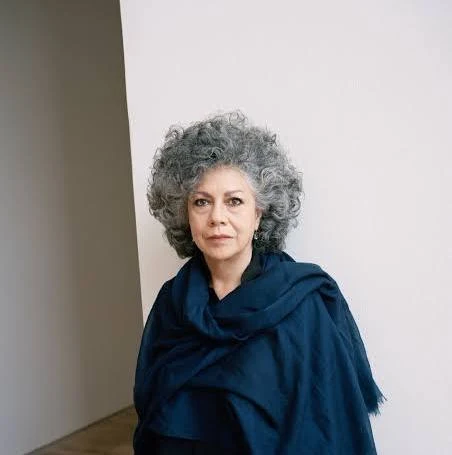 Doris Salcedo is a Colombian sculptor, born in 1958 in Bogotá, whose life and art have been deeply shaped by the political and historical experiences of her country. She completed a Bachelor of Fine Arts at the Universidad Jorge Tadeo Lozano in Bogotá in 1980, before traveling to New York, where she earned a Master of Fine Arts degree from New York University. She later returned to Bogotá to teach at the Universidad Nacional de Colombia. Upon returning to Colombia, Salcedo became deeply interested in the human consequences of violence. Her work is permeated by a sense of loss and mortality, rooted in her personal history; members of her family were among the many who disappeared in politically troubled Colombia. Her art addresses the fact that, while the deaths of loved ones may be mourned, their disappearances leave an unbearable void(1). Her sculptures often respond to the testimonies of friends and relatives of victims killed during her lifetime. They frequently take the form of reworked household furniture, interior design elements or clothing and textiles left behind by missing persons.
*
Between 1985 and 1990, Salcedo’s work was influenced by Joseph Beuys, whose practice demonstrated to her the possibility of confronting trauma in historical terms. During this period, her art focused on revealing facts concealed by official history, with the essential theme being the pain of human experience. The artist often incorporates textiles and various materials in her works. In 1989–1990, she created Las Camisas (Untitled), a work addressing the fate of missing people, the impact of violence on their families, and the daily rituals these families perform to remember them. The piece consists of a stack of pristine white linen men’s shirts belonging to those who disappeared ‘under unexplained circumstances’. Other works using fabric include A Flor de Piel (literally translated from Spanish as Flower and Skin, 2011–2012), created in memory of the torture and death of a Colombian nurse, a victim of violence. For this piece, Salcedo crafted a fabric-carpet from thousands of rose petals, forming a shroud that exists in a space between life and death, between materiality and immateriality. Another example is Disremembered X (2020–2021), a series of three ethereal fabric shrouds. For these, Salcedo inserted thousands of needles into translucent white fabric, sewn from raw silk with an almost gauzy softness, creating a hauntingly beautiful, penitential-like garment. The work addresses the impossibility of fully expressing grief and mourning, the lack of understanding from others and the fading of memory.
*
In this presentation, I am going to discuss selected installations by Doris Salcedo in chronological order, according to date of their creation. My focus will be on three works made at different times, linked by the artist’s use of fabric as a primary material imbued with special meaning and symbolic significance. I will examine objects in which Salcedo incorporates ready-made, authentic clothing belonging to people who disappeared under unclear circumstances, as well as installations that explore the symbolic power of textiles. Central to these works is the very essence of weaving: the intertwining of threads, the material’s function, its feminine connotations, and the archetype of female creation.
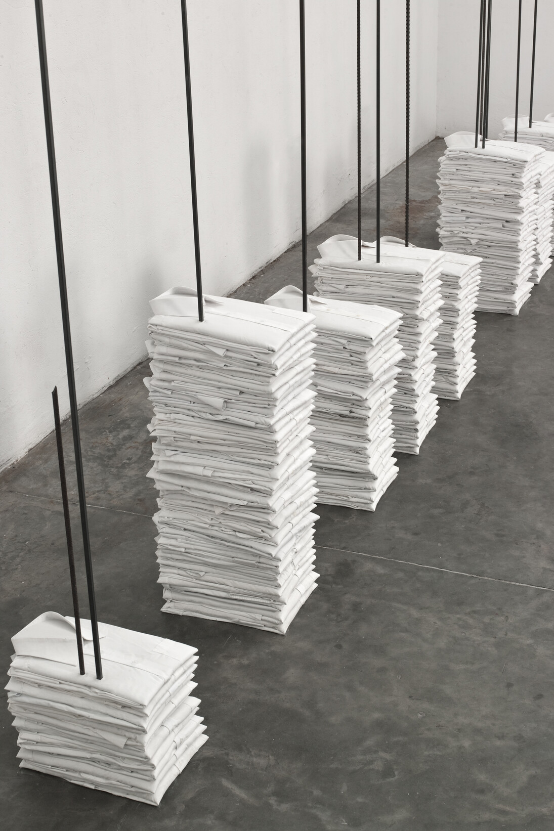 In 1989–1990, she created the installation Las Camisas (Untitled), a work dedicated to missing persons. On the one hand, the project was intended to commemorate the deaths of innocent people fighting drug crimes in Colombia, and on the other hand, it referred to rituals of commemorating the dead. By evoking the traditional folk customs of the Colombian Indians relating to mourning, burial and grief for the dead, Salcedo indirectly condemns those responsible for unexplained deaths. Often, the relatives of the dead and missing are never able to bury their loved ones, and all that remains are their clothing behind. The installation consists of a pile of immaculate white linen shirts belonging to people who disappeared ‘under unexplained circumstances’. The shirts are held together with steel rods; the work speaks of sacrifice and memory, of suffering and politics in Colombia.
Doris Salcedo’s artistic practice contributes to the development of the art of memory and awareness. Although her pieces carry a sorrowful undertone, they cannot be classified as traditional monuments. The artist materialises absence, oppression and the gap between injustice and power. Her sculptures and installations address the violence and conflicts of everyday life in her native Colombia, serving as both a reflection on and a response to them. Salcedo perceives her art as a representation of civic conscience, while simultaneously acting as a witness and an accuser. Although her art often appears to be inspired by the personal experiences of the victims, she directs our attention toward universal issues of violence and the human condition. In a sense, her artworks give voice to members of Colombian society who have been brutally repressed, silenced and controlled by fear, while also highlighting a sense of community – and even resistance – through collective memory and the shared experience of loss. ‘Salcedo employs materials, objects and traces of everyday life belonging to the victims, such as clothing, to emphasize the humanity of those who have been anonymised by violence.’
The installation Las Camisas was one of Doris Salcedo’s first works, presented in Bogotá at the Garcés Velázquez Gallery(2). It consists of a series of metal construction fragments used as supports for cots and hospital beds. Salcedo wraps them in natural fibres resembling bandages, as if covering some kind of wound. Alongside these structures – the earliest in her oeuvre, dedicated to what she calls ‘mourning actions’ – she installed a series of pieces composed of white cotton men’s shirts, carefully arranged in eleven columns. The shirts are stiffened with plaster and pierced with long metal rods. From this work onward, the theme of grief and mourning became central to her artistic practice. Las Camisas is the artist’s response to the massacres that occurred on the Hondura and La Negra banana plantations, during which peasants were murdered for reasons that remain not fully explained. Through this work, the artist evokes the presence of the absent human body in a deeply moving way, addressing the crime without ever showing it directly. Clothes left behind by the deceased, who relatives are often unable to bury, remain the only material testimony. The white men’s shirts refer both to the traditional garments worn by plantation workers and to attire associated with mourning. Arranged in uneven stacks, they become a measure of human life itself.
The artwork is composed of only two elements that together form a complete whole: white shirts and metal rods. The gallery walls are also white, and against this stark backdrop the protruding metal elements evoke associations with instruments of torture. The steel rods are black and uniform in height, though their number varies from stack to stack. Not all are nailed in exactly the same place, yet all are positioned on the same side – on the left – and each one is placed above the midpoint of the shirt.
Through contrast – the immaculate whiteness of the shirts, their careful ironing and meticulous folding, reminiscent of the care once taken by women who prepared these garments for their men – and the brutality with which they are pierced by metal rods at chest height, the artist appeals to emotion, to the grief of loss. At the same time, this contrast provokes a sense of protest and dissent against the strategies of politicians, who attempt to camouflage the crime.
Another work by Doris Salcedo, in which the artist used weaving in an unconventional way, is the piece created between 2011 and 2016 titled A Flor de Piel (literally translated from Spanish as ‘Like the Flower of Skin’ or ‘Flower and Skin’)(3).
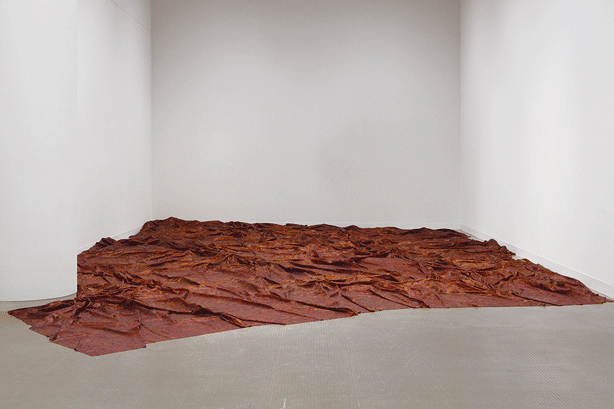 This Spanish idiom means ‘an extreme emotion’ –a feeling so strong that it demands to be expressed. The phrase ‘flor de piel’ in Spanish evokes a connection between a flower and human skin, suggesting the intensity of a feeling that manifests itself physically by tinting the surface of the body red. Salcedo herself describes this piece as the performance of a funeral ritual that was denied to the deceased. A Flor de Piel – often referred to by critics as a sculpture – was created in memory of an abducted, tortured and murdered Colombian nurse, whose name remains unknown. The young woman had provided medical assistance to the wounded on both sides of the conflict during the Colombian civil war (1964-2016)(4). The fabric-sculpture consists of thousands of rose petals, hand-stitched together into a delicate, lightweight shroud. Carefully arranged on the floor, it gently ripples with the movement of the air. Each petal was chemically treated to preserve its dark colour and pliable texture, then sewn together with surgical thread – just as a surgeon stitches a wound(5). The rose petals, subject to natural decay, exist in a state between life and death; they are so fragile that even the slightest touch can cause them to tear. It is precisely this fragility and ephemerality that constitute the core of the work. Salcedo’s intention was to create what she calls an ‘immaterial material’. Reflecting on the piece, the artist described it as ‘a floral offering for all victims, for all those affected by violence’.
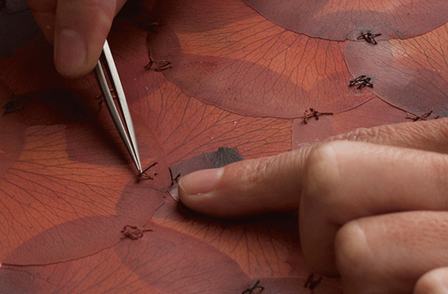 ‘Suturing the petals is very important because it was a way to bring together all these parts,’ Salcedo has said. ‘Violence destroys everything. Torture destroys bodies (the recovered body of the nurse was dismembered – E.J.). The idea is to bring them together and unite them and recover the force that they had’(6). The fabric made of rose petals, dedicated to the tortured nurse, took nearly a year to complete. The painstaking, patience-demanding process of joining thousands of flower petals – symbols of life and death among other meanings – was transformed by the artist into a ritual act meant to replace the traditional washing and then wrapping of a dead body in cloth. In many cultures, this gesture expresses care for granting the deceased a dignified burial, a responsibility traditionally entrusted to women. Drawing on forms of expression long associated with women’s work – such as weaving, sewing, attention to detail and patience – Salcedo uses a ‘living’ material, dying rose petals and their fragility, to create a symbolic union of life and death, of the material and the immaterial. Salcedo’s ‘rose shroud’, fragile (literally) like human life, appears from a distance to be made of thin skin, while up close it reveals an almost immaterial texture. Its mesmerising surface, inviting tactile contact and trembling with even the slightest breath of air, can only be observed and contemplated. The delicacy of the material, the unsettling blood-brown colour and the visible stitching that binds the individual petals together imbue the work with a prayerful, commemorative character. By using flower petals for her fabric-sculpture, Salcedo – whether consciously or not – followed in the footsteps of women-weavers, whose traditions stretch back at least eight thousand years, to the very beginnings of textile history, when plant fibres, grasses, strips of animal hide, hair, intestines and vines were intertwined to form cloth-like structures.
In interviews with the artist and in films documenting the painstaking process of creating A Flor de Piel, Doris Salcedo emphasizes the collaborative effort of the team that helped realize the work.
The next work by Doris Salcedo to be discussed is Disremembered X(7)( )(created in 2020–2021.
By choosing this title, the artist refers to the word ‘disremember’, used by Toni Morrison in her 1987 novel Beloved. In English, the term denotes a deliberate forgetting – an erasure of tragic events from the past that continue to haunt, causing a quiet, persistent pain and shaping the present. This installation was inspired by conversations with hundreds of American mothers who had lost their children to gun violence. A particularly tragic place is Chicago, where in 2021 the number of firearm-related deaths reached its highest level in 25 years. ‘When you lose a parent, you’re called an orphan, but the grief mothers feel is something we are not even able to name,’(8) says Salcedo.
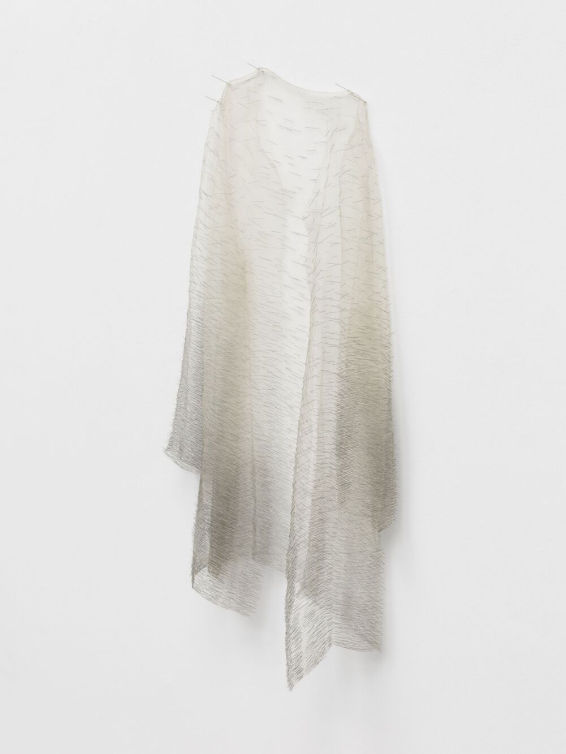 The installation consists of four components resembling ‘death gowns’ or shrouds. They have various sizes, yet each is a loose, almost transparent garment woven from raw white silk threads, soft and delicate like medical gauze or a bandage. The beauty and delicacy of the textile are deceptive – in the artist’s intention, it functions as a penitential or death shirt. With Disremembered X Doris Salcedo – through her characteristically subtle yet profoundly moving approach – speaks, or rather cries out about the impossibility of expressing one’s grief, the lack of understanding from those who have not endured a similar tragedy, and ultimately the silencing and gradual disappearance of memory. Into the translucent white fabric, the artist has woven thousands of tiny needles, giving it an ethereal luminosity while simultaneously repelling the viewer, discouraging any attempt to touch it. The small needles, entwined with silk threads into the silk fabric, form a mysterious material that hovers between chainmail, an angelic robe, and a shroud of death. Thousands of needles interwoven in the silk gauze make the gowns extremely heavy; this sense of weight is evident in the arrangement of the folds, distinct ‘sagging’ of garments designed for no living body. Salcedo’s ‘death gowns’, draped at various angles, suspended against a stark white wall – sometimes appearing to hang from invisible hangers or casually thrown over a nail, evoke a sense of disorientation. Visitors move through the space in silence, accompanied only by a faint rustle – a quiet plea for remembrance. The fabric itself is almost invisible; the light, the sheen of thousands of needles and the delicacy of the material render it nearly immaterial, like ‘the echo of a child’s voice that is no longer there…’(9).
 Doris Salcedo’s work resonated powerfully in the United States. Individuals who had lost children to the widespread availability of firearms responded with profound emotion, sharing their grief, among other ways, through social media. Leading American publications featured detailed articles examining Salcedo’s work alongside the broader context of its creation(10). The government was accused of failing to respond to successive massacres, of allowing society to push the issue into oblivion, of erasing the memory of murdered children, of isolating those affected by such tragedies, and of perpetuating deeply rooted racism. Disremembered X – seemingly ethereal – speaks through its almost tangible presence of pain, loss and mourning. The artist brings to the surface a past that society has sought to repress, conjuring the ghosts of earlier tragedies. The strength of this work – and of Salcedo’s art as a whole – lies in the uncompromising way she reveals trauma, emotion and empathy. ‘Each time we experience a massacre, we suddenly remember past massacres but have already forgotten what these families endured, and it’s that very forgetfulness that these pieces address,’ says Salcedo(11).
Selected works in which Doris Salcedo employs fabric are described by the artist as ‘a topology of mourning’. All of these – textiles, sculptures, installations, as well as public projects such as Atrabiliarios (1992–2004), Istanbul (2003), Shibboleth (2007)) – represent, in Salcedo’s words, ‘a constant suspension between the present and the past’ / ‘What I'm trying to get out of these pieces is that element that is common in all of us’ (12). In Salcedo’s work, fabric and the acts of sewing, weaving, and intertwining acquire the significance of a portrait. As the artist explains, it is ‘not only a portrait of disappearance, but a portrait of the survivors' mental condition of uncertainty, longing and mourning,’(13) says Salcedo. The delicacy of the materials in Salcedo’s fabric-sculptures-installations, their ethereality, luminosity, fragility and the threat to their permanence expres intense experiences; they speak of the horror of violence, of death, and of grief. This contradiction constitutes the essence of her art and of herself, who – as she admits(14) – is driven by an obsessive need to reveal the experiences of the most vulnerable and anonymous people, whose names have not been preserved in any records: victims of political violence, victims of governmental negligence and indifference.
The Colombian artist also seeks to explore and convey the emotions of tortured individuals, to understand their fear and to preserve the memory of their experiences. The political dimension of Salcedo’s practice has a universal scope – it encompasses human tragedies, reflecting on the value of life and giving voice to those whom the world prefers to forget. By weaving a shroud-tapestry from red rose petals or sewing luminous ‘mourning gowns’, the artist positions herself on the fragile boundary between the ‘silent prayer’ and the cry of the victims and the despair of their loved ones, between the 'femininity' of the materials from which she creates her works and the ultimate seriousness of the issues her pieces address. The phenomenon of an artist of this stature – one of the few in the 21st century – remains unique, and I am grateful to the organisers of the Paris conference for allowing me, even in such a fragmentary form, to present a selection of her works.
__________________________________________
1 - Cf. Nancy Princenthal, Silence Seen, in: Doris Salcedo¸ London: Phaidon Press Limited, 2000, p. 45
2 - https://bananacraze.uniandes.edu.co/obras/arte,violencias/doris-salcedo/ (2.10.2025).
3 - The installation Flor de Piel was first presented at the Harvard Art Museums as part of Doris Salcedo’s solo exhibition.
4 - The Colombian civil war lasted from 1964 to 2016. It was fought between the government, supported by the AUC (United Self-Defence Forces of Colombia), and the left-wing FARC guerrillas (Revolutionary Armed Forces of Colombia), who were backed by peasants, as well as other groups. In its early years, FARC financed its military and social activities through kidnappings for ransom, targeting mainly politicians and local elites. By the late 1970s, the guerrilla organization had also begun to engage in cocaine trafficking. In 1985, FARC co-founded the left-wing political party Patriotic Union. During the 1986 elections, the party’s members won 350 local government seats. The success of the party, however, triggered severe repression against its representatives. From 1988 to 1992, between four and six thousand members and supporters of the Patriotic Union were killed. These murders were carried out by government forces, paramilitary groups and drug-cartel organisations. The reprisals prevented the party from developing, and many of its members left Colombia.
Cf. Cynthia Arnson: Comparative Peace Processes in Latin America. 1999.
5 - https://museodememoria.gov.co/arte-y-cultura/a-flor-de-piel/ (3.10.2025).
6 - Doris Salcedo and Tim Marlow, Doris Salcedo on A Flor De Piel and Plegaria Muda, White Cube, May 25, 2012, accessed June 6, 2013. https://pmc.ncbi.nlm.nih.gov/articles/PMC5363096/ (3.10.2025).
7 - The title of Doris Salcedo’s installation refers to a word used by Toni Morrison (1931–2019), the American writer with feminist views, professor at the University at Albany and Princeton, who received the 1993 Nobel Prize in Literature.
8 - Gabriella Angeleti, Doris Salcedo on her new work, a ghostly reflection on gun violence. “The Art Newspaper”, 2022, 18 July). https://www.theartnewspaper.com/2022/07/18/doris-salcedo-tells-us-about-her-newest-work-a-ghostly-reflection-on-gun-violence (6.10.2025).
9 - https://www.guggenheim.org/audio/track/description-of-disremembered-x-2020-2021 (4.10.2025).
10 Cf. Gabriella Angeleti, Doris Salcedo on her new work, a ghostly reflection on gun violence. ‘The Art Newspaper’, 2022, 18 July): ‘In the weeks after the conceptual artist Doris Salcedo unveiled her new commission at the Glenstone museum, a work that reflects on mothers impacted by gun violence in the US, the country’s lawmakers took steps forwards and backwards on gun control. On 25 June, President Joe Biden signed a bill expanding background checks and other incremental measures into law. Two days earlier, the Supreme Court struck down a New York law restricting citizens’ ability to carry guns in public. In the previous month, following the elementary school massacre in Uvalde, Texas—where, on 25 May, 18-year-old Salvador Ramos executed 19 students and two teachers—there were more than 70 mass shootings nationwide.
https://www.theartnewspaper.com/2022/07/18/doris-salcedo-tells-us-about-her-newest-work-a-ghostly-reflection-on-gun-violence). 5.10.2025.
11 - ibidem.
12 - Michelle Aldredge, Artist Doris Salcedo: i began to conceive of works based on nothing, 2012, 19 January. https://gwarlingo.com/2012/artist-doris-salcedo-i-began-to-conceive-of-works-based-on-nothing/ (6.10.2025).
13 - Ibidem.
14 - https://www.whitecube.com/artists/doris-salcedo: ‘driven by the obsessive need to render visible the experiences of the most vulnerable and most anonymous victims of political violence. This viewpoint has confined my work into a fragile threshold, a threshold filled with impossible contradictions that will remain unsettled in each and every one of my pieces’. (6.10.2025).